CMA USA Part 2 syllabus
Table of Contents
CMA USA Part 2 Syllabus 2026: Complete Guide
The CMA USA Part 2 syllabus for 2026 is focused on Strategic Financial Management, designed to build advanced skills in financial decision-making, analysis, and business strategy.
CMA (Certified Management Accountant) is a globally recognized professional certification in management accounting that develops expertise in finance, planning, control, analysis, and decision support. It is awarded by the Institute of Management Accountants (IMA), USA, which is the official body responsible for conducting and governing the CMA program worldwide.
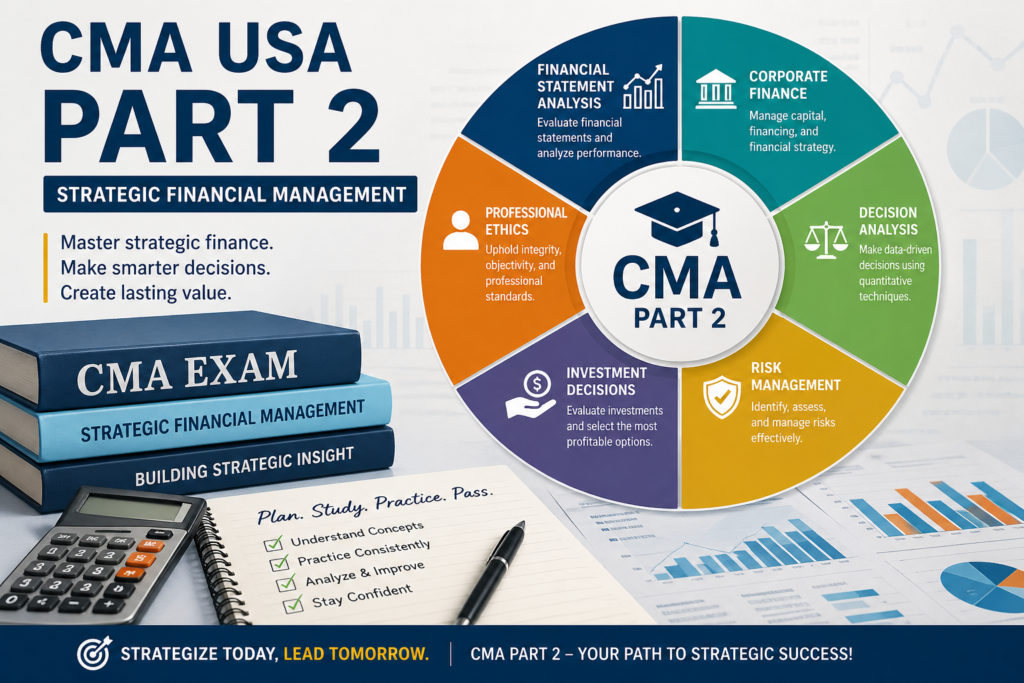
Part 2 of the CMA exam covers key areas such as financial statement analysis, corporate finance, decision analysis, risk management, investment decisions, and professional ethics. It prepares candidates for senior-level finance roles by focusing on real-world strategic applications.
What is CMA USA Part 2 (Strategic Financial Management)?
CMA USA Part 2, titled Strategic Financial Management, focuses on advanced financial decision-making and strategic analysis. It equips candidates with skills to evaluate financial performance, manage risks, and make investment decisions in a business context.
The syllabus covers areas such as financial statement analysis, corporate finance, decision analysis, risk management, and professional ethics. The exam tests both theoretical understanding and practical application through multiple-choice and essay questions, preparing professionals for leadership roles in finance and management.
CMA Part 2 Exam Structure and Format
The CMA Part 2 exam is designed to assess both knowledge and application of strategic financial concepts. It consists of two sections: 100 multiple-choice questions followed by two essay questions. Candidates must complete the MCQ section within three hours and achieve a minimum score to unlock the essay section. The total exam duration is four hours.
The essay portion tests analytical skills through real-world scenarios, requiring written responses and calculations. The exam is computer-based and conducted at authorized testing centers worldwide.
CMA USA Part 2 Syllabus Overview
| Section | Weightage |
|---|---|
| Financial Statement Analysis | 20% |
| Corporate Finance | 20% |
| Decision Analysis | 25% |
| Risk Management | 10% |
| Investment Decisions | 10% |
| Professional Ethics | 15% |
Financial Statement Analysis (20%)
Financial Statement Analysis in CMA Part 2 focuses on evaluating a company’s financial health using key reports such as the income statement, balance sheet, and cash flow statement. Candidates learn to analyze profitability, liquidity, solvency, and efficiency through ratio analysis and trend evaluation. The topic also covers common-size statements, comparative analysis, and the impact of accounting choices on financial results.
Emphasis is placed on interpreting data to support business decisions, identify risks, and assess performance. Strong analytical skills in this area are essential for strategic planning and effective financial management in real-world scenarios.
Corporate Finance (20%)
Corporate Finance in CMA Part 2 focuses on managing a company’s financial resources to maximize shareholder value. It covers key topics such as cost of capital, capital structure, working capital management, and dividend policies. Candidates learn how to evaluate financing options, assess risk-return trade-offs, and make strategic funding decisions.
The section also includes financial markets, instruments, and corporate restructuring concepts. Emphasis is placed on applying financial theories to real business scenarios, enabling professionals to support long-term growth, optimize capital allocation, and enhance overall financial performance within an organization.
Decision Analysis (25%)
Decision Analysis in CMA Part 2 focuses on using quantitative techniques to support effective business decisions. It includes concepts such as cost-volume-profit analysis, marginal analysis, pricing decisions, and budgeting methods. Candidates also study linear programming, probability, and forecasting tools to evaluate different business alternatives.
The aim is to help managers choose the most profitable and efficient course of action under varying conditions. This section emphasizes problem-solving, logical thinking, and data-driven decision-making, which are essential skills for strategic financial management and operational planning in real-world business environments.
Risk Management (10%)
Risk Management in CMA Part 2 focuses on identifying, assessing, and controlling financial and operational risks in an organization. It covers types of risk such as market risk, credit risk, liquidity risk, and operational risk. Candidates learn techniques for risk measurement, hedging strategies, and internal controls to minimize uncertainty.
The section also includes the use of derivatives like futures and options for risk mitigation. Emphasis is placed on building effective risk frameworks that support stable financial performance, protect assets, and ensure informed strategic decision-making in dynamic business environments.
Investment Decisions (10%)
Investment Decisions in CMA Part 2 focus on evaluating long-term capital projects and selecting the most profitable investment opportunities. It includes capital budgeting techniques such as net present value (NPV), internal rate of return (IRR), payback period, and profitability index. Candidates learn how to assess cash flows, risk factors, and time value of money to make sound investment choices.
The section also emphasizes comparing alternative projects and prioritizing those that maximize shareholder wealth. Strong analytical and financial evaluation skills are essential for effective strategic investment planning in organizations.
Professional Ethics (15%)
Professional Ethics in CMA Part 2 focuses on maintaining integrity, transparency, and accountability in financial and managerial practices. It covers ethical responsibilities of management accountants, including confidentiality, objectivity, and professional competence. Candidates learn to handle ethical dilemmas, conflicts of interest, and corporate misconduct scenarios.
The section is based on IMA’s Statement of Ethical Professional Practice, which guides decision-making in real business situations. Emphasis is placed on ethical judgment, compliance with laws and standards, and promoting trust in financial reporting and organizational decision-making processes.
Detailed Topic-Wise CMA Part 2 Breakdown
| Section | Key Topics Covered |
|---|---|
| Financial Statement Analysis | Ratio analysis, common-size statements, trend analysis, liquidity & profitability evaluation, cash flow analysis |
| Corporate Finance | Cost of capital, capital structure, working capital management, dividend policy, financial markets |
| Decision Analysis | CVP analysis, marginal analysis, pricing decisions, budgeting, linear programming, forecasting, probability |
| Risk Management | Market risk, credit risk, liquidity risk, operational risk, hedging, derivatives, internal controls |
| Investment Decisions | Capital budgeting, NPV, IRR, payback period, profitability index, project evaluation |
| Professional Ethics | IMA ethical standards, confidentiality, integrity, conflicts of interest, ethical decision-making frameworks |
CMA Part 2 Study Plan for Beginners
A beginner-friendly CMA Part 2 study plan should be structured and consistent. Start by understanding the syllabus and dividing it into six main sections: Financial Statement Analysis, Corporate Finance, Decision Analysis, Risk Management, Investment Decisions, and Ethics. In the first month, focus on building conceptual clarity for each topic. In the second month, move to solving practice questions and numerical problems, especially in Decision Analysis and Investment Decisions.
The third month should be dedicated to revision, mock exams, and time management practice. Allocate at least 2–3 hours daily if you are working, or 4–5 hours if you are a full-time student. Revise ethics regularly as it is theory-based and scoring. Practice MCQs and essay questions together to improve exam readiness. Consistency, revision, and mock tests are key to clearing CMA Part 2 on the first attempt with confidence.
Common Mistakes to Avoid in CMA Part 2
- Ignoring the syllabus weightage and spending equal time on all topics
- Weak understanding of core concepts like CVP, NPV, and ratio analysis
- Over-reliance on memorization instead of application-based learning
- Poor time management during MCQ and essay practice
- Skipping regular revision and cumulative practice
- Not practicing enough essay-type questions
- Neglecting ethics, assuming it is easy and less important
- Avoiding mock exams and real exam simulation
- Not analyzing mistakes from practice tests
- Starting revision too late before the exam
Tips to Pass CMA Part 2 on First Attempt
To pass CMA Part 2 on the first attempt, focus on understanding concepts rather than memorizing formulas. Create a structured study plan covering all six syllabus areas with more attention to high-weight topics like Decision Analysis and Financial Statement Analysis. Practice MCQs daily to improve speed and accuracy, and regularly attempt essay questions to build writing skills.
Use mock exams to simulate real test conditions and manage time effectively. Revise consistently instead of last-minute preparation. Strengthen weak areas through repeated practice and review mistakes carefully. Staying disciplined, consistent, and exam-focused is key to achieving success in CMA Part 2.
CMA Part 2 Passing Rate and Difficulty Level
The CMA USA Part 2 exam has a moderate to challenging difficulty level, with a global pass rate of around 45% to 50%.
This means only about half of the candidates clear it in each attempt, making it a competitive professional exam. However, Part 2 is generally considered slightly easier than Part 1 because of its more application-based and finance-focused topics.
Success mainly depends on consistent practice, strong conceptual understanding, and good time management during MCQs and essays.
CMA Part 2 vs Part 1: Key Differences
| Feature | CMA Part 1 | CMA Part 2 |
|---|---|---|
| Focus Area | Financial Planning, Performance & Analytics | Strategic Financial Management |
| Core Nature | Costing & Internal Management Accounting | Corporate Finance & Decision Making |
| Key Topics | Budgeting, Costing, Variance Analysis, Internal Controls | Financial Statement Analysis, Risk, Investment, Ethics |
| Difficulty Level | Concept-heavy & technical | Analytical & application-based |
| Calculation Weight | High | Moderate to High |
| Strategic Focus | Operational decisions | Long-term financial decisions |
| Exam Emphasis | Cost control & performance | Value creation & financial strategy |
| Ethics Coverage | Included | Included (more application-based) |
| Overall Approach | Internal business focus | External & strategic finance focus |
FAQs on CMA USA Part 2 Syllabus
1. What is CMA Part 2 about?
CMA Part 2 focuses on Strategic Financial Management, covering financial analysis, corporate finance, decision-making, risk management, investment decisions, and ethics.
2. Is CMA Part 2 difficult?
It is moderately difficult and requires strong conceptual understanding and regular practice of MCQs and essays.
3. What are the main topics in CMA Part 2?
Key topics include Financial Statement Analysis, Corporate Finance, Decision Analysis, Risk Management, Investment Decisions, and Professional Ethics.
4. How many hours should I study daily?
Working professionals should study 2–3 hours daily, while full-time students may need 4–5 hours.
5. Is CMA Part 2 easier than Part 1?
Many candidates find Part 2 slightly easier due to its application-based finance concepts.
6. What is the passing score?
You need at least 360 out of 500 to pass the exam.