CMA USA Part 1 syllabus
Table of Contents
Introduction to CMA USA Part 1
CMA USA Part 1 focuses on Financial Planning, Performance, and Analytics, forming the foundation of management accounting. It equips candidates with the skills needed to analyze financial data, support strategic decisions, and improve organizational performance. This part covers key areas such as financial reporting, budgeting, cost management, internal controls, and technology-driven analytics.
Designed for professionals aiming to work in corporate finance and manufacturing environments, Part 1 emphasizes practical application rather than theory alone. Mastering this section not only builds strong analytical thinking but also prepares candidates to handle real-world business challenges effectively in a dynamic financial environment.
Overview of CMA Part 1 Syllabus
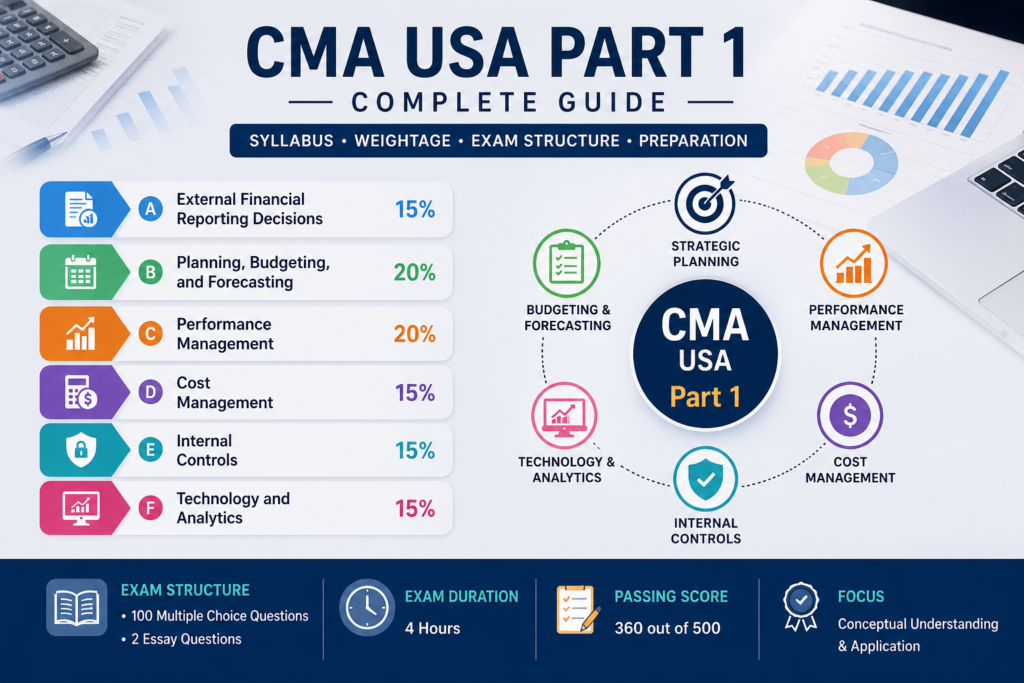
The CMA USA Part 1 syllabus is designed to build a strong foundation in financial planning, performance evaluation, and analytical decision-making. It is structured into six key areas: External Financial Reporting Decisions, Planning, Budgeting and Forecasting, Performance Management, Cost Management, Internal Controls, and Technology and Analytics.
Each section carries a specific weight, ensuring balanced coverage of both technical and strategic topics. The exam is divided into multiple-choice questions and essay-based scenarios, testing both conceptual understanding and practical application. Candidates are expected to not only learn core concepts but also apply them in real business situations. This comprehensive structure makes Part 1 highly relevant for professionals aiming to strengthen their role in management accounting and financial leadership.
External Financial Reporting Decisions
This section focuses on the preparation and interpretation of financial statements in line with standard accounting principles. It covers key topics such as revenue recognition, inventory valuation, long-term assets, and financial statement analysis. Candidates learn how financial information is reported to external stakeholders and how accounting choices impact business decisions.
The emphasis is on understanding concepts rather than memorization, enabling professionals to analyze reports critically and ensure accuracy, transparency, and compliance in financial reporting practices.
Planning, Budgeting, and Forecasting
This section focuses on how organizations plan their financial future through structured budgeting and forecasting processes. It covers key topics such as strategic planning, types of budgets, variance analysis, and forecasting techniques. Candidates learn to align financial plans with business objectives while adapting to changing conditions.
The emphasis is on practical application, helping professionals develop realistic budgets, evaluate performance, and support informed decision-making that drives efficiency, cost control, and long-term organizational growth.
Performance Management
This section focuses on evaluating and improving organizational performance through effective measurement systems. It covers key areas such as variance analysis, responsibility accounting, balanced scorecards, and key performance indicators (KPIs). Candidates learn how to assess operational efficiency and align performance with strategic objectives.
The emphasis is on using financial and non-financial metrics to monitor results, identify issues, and drive continuous improvement, enabling better decision-making and accountability across different levels of the organization.
Cost Management
This section focuses on understanding, analyzing, and controlling costs to improve business profitability. It covers key topics such as cost behavior, costing systems, activity-based costing (ABC), and cost allocation methods. Candidates learn how costs are measured, assigned, and managed across different business functions.
The emphasis is on using cost information for decision-making, pricing, and operational efficiency, helping organizations optimize resources, reduce waste, and maintain a competitive advantage in dynamic business environments.
Internal Controls
This section focuses on systems and processes designed to safeguard assets, ensure reliable financial reporting, and promote operational efficiency. It covers key areas such as risk management, governance frameworks, control activities, and internal auditing. Candidates learn how to identify potential risks, implement effective controls, and monitor compliance within an organization.
The emphasis is on creating a strong control environment that prevents fraud, enhances accountability, and supports accurate and timely decision-making across all levels of the business.
Technology and Analytics
This section focuses on the role of technology and data in modern management accounting. It covers key areas such as information systems, data governance, analytics tools, and data visualization techniques. Candidates learn how to use technology to collect, process, and analyze financial and operational data.
The emphasis is on transforming data into meaningful insights that support decision-making, improve efficiency, and enhance strategic planning in a rapidly evolving digital business environment.
Weightage and Exam Structure
The CMA USA Part 1 exam is designed to test both conceptual understanding and practical application. It consists of multiple-choice questions (MCQs) and essay scenarios. The MCQs carry the majority weight, while essays test analytical and problem-solving skills based on real-world business situations.
Each syllabus area has a defined weightage, ensuring balanced coverage across all topics. Candidates must manage time effectively, as the exam is both knowledge-driven and application-oriented.
| Section | Topic | Weightage |
|---|---|---|
| A | External Financial Reporting Decisions | 15% |
| B | Planning, Budgeting, and Forecasting | 20% |
| C | Performance Management | 20% |
| D | Cost Management | 15% |
| E | Internal Controls | 15% |
| F | Technology and Analytics | 15% |
Preparation Strategy for CMA Part 1
A well-planned strategy is essential to clear CMA USA Part 1 effectively. Start by understanding the syllabus and weightage, then prioritize high-scoring areas like budgeting, performance management, and financial reporting. Build a structured study plan with daily and weekly targets to ensure consistent progress.
Focus on conceptual clarity rather than memorization, especially for cost management and internal controls. Practice MCQs regularly to improve speed and accuracy, and solve mock exams to simulate real exam conditions. Allocate time for revision in the final weeks to strengthen weak areas.
Using quality study materials and maintaining discipline throughout the preparation journey significantly increases the chances of success in the CMA Part 1 exam.
Common Challenges in CMA Part 1
One of the main challenges in CMA USA Part 1 is understanding the depth of conceptual topics, especially in budgeting, variance analysis, and cost management. Many candidates struggle with time management during the exam due to lengthy MCQs and case-based questions.
Another common issue is lack of practice with application-based scenarios, which reduces accuracy under pressure. Internal controls and financial reporting sections can also be tricky due to their technical nature. In addition, balancing preparation with work or studies becomes difficult for many learners.
Exam-Day Strategy
Overcoming these challenges requires consistent practice, strong conceptual clarity, and regular revision of key topics.
Final Thoughts
CMA USA Part 1 lays a strong foundation for a career in management accounting and corporate finance. It develops essential skills in financial analysis, planning, cost control, and performance evaluation. While the syllabus may seem extensive, a structured approach and consistent practice make it manageable.
Success in this exam depends on conceptual understanding and application rather than rote learning. With the right preparation strategy and discipline, candidates can confidently clear Part 1 and move one step closer to earning the CMA certification.
FAQs
1. Is CMA USA Part 1 difficult?
CMA Part 1 is moderately challenging, mainly because it focuses on application-based learning. With proper preparation and practice, it becomes manageable.
2. How long does it take to prepare for CMA Part 1?
On average, candidates take 2–4 months depending on their background in accounting and study consistency.
3. What is the passing score for CMA Part 1?
You need a minimum score of 360 out of 500 to pass the exam.
4. Can working professionals clear CMA Part 1?
Yes, many working professionals clear it with disciplined study schedules and focused revision plans.
5. What is the best way to study for CMA Part 1?
Focus on understanding concepts, practicing MCQs regularly, and revising high-weightage topics frequently for better retention and exam performance.